Review: Tempo Advance app

Download this app on the iTunes store

app.PNGMy review: 5 stars. Tempo Advance is probably my most-used practice tool. It is not for the beginning student, but rather for students who are looking to go deep in their practice. If you have an iPhone and are an intermediate-to-advanced player, this is the metronome to buy. At $3.99, it is more expensive than most metronome apps, but if you really use it, it is worth every penny.

What do I love about it?

The Interface
The interface is intuitive without being over-simplified. For students who are uncomfortable with anything beyond a simple click or 4 beat, it might require some experimentation, but once you understand the layout on the main screen of the app, it becomes easy to operate. Short of having physical buttons, this is as good as it gets.

The Sounds
Multiple beat sounds are available, including a collection that sounds believably close to a drum set. This comes in handy if you’re working on a phrase that you have to really slow down so that sounds for the 8th and 16th subdivisions are required. Additionally, I’ve found removing the sound entirely on some beats helps me hone my sense of timing.

Automatic Acceleration/Deceleration of Tempo
Want to loop a four-measure phrase and go up by 5 beats per minute on each repetition? This app can do that. Or perhaps you want to gradually slow down by 1 beat per minute every 5 seconds — that can be done as well. No one gets good at an instrument without some repetition; this app allows you to be that much more strategic with your practice technique.

As I implied above, this is not the best app for beginners and/or students who don’t have a fairly firm grasp on rhythm concepts — but the maker of this app (Frozen Ape) does make a metronome app for beginners: Tempo Light. It has a similar style, but is simpler to operate without some of the more mind-boggling features. It would serve as a good stepping stone to the more professional app reviewed here.

Download this app on the iTunes store

What do you think? Leave your thoughts in the comments below.


Wes Freeman is private guitar lesson teacher in the Atlanta metro area of Georgia. He teaches lessons primarily in the cities of Lilburn, Snellville, Marietta, Decatur, and Brookhaven. Learn more about taking lessons with Wes on his Lessons page.

Five Qualities You Need to Succeed at Guitar

Over the past sixteen years I have taught all kinds of people with many styles of learning, but whether they lean toward more structured and studious or loose and free-spirited, a number of things stand out as to which ones are successful in making obvious progress throughout their time with me. My hope in sharing this is that if you’re someone with that dream of playing the guitar, you can take a look at the following qualities before you sink a bunch of time and money into it.

1. Good guitar students are, at some point, going to have to have truck-loads of patience.

I might as well get the bad news out of the way right away. Whatever your level of natural musical talent, you’re going to run into obstacles — perhaps even obstacles that seem insurmountable. We all have limitations. Sometimes it might take weeks or months of persistent work on a particular issue before you see a breakthrough. All I know to tell you is that the work is worth it, and what you learn about yourself and how you learn is usually more valuable than the song, solo, or groove that you are working on.

2. Good guitar students find a way to enjoy what they are doing.

So what do you do when you find that that song you would love to be able to play is a beast to learn? You learn to love the process. Even songs that are easy for you are going to take effort to memorize, and I’ve found that songs that seemed like they would be easy often take a lot longer than I thought they would to get down. If you’re only getting into music for the payoff of being able to play a song at performance level, then you have a lot of drudgery ahead of you. It is better to view the learning process as an end in itself and learn to lose yourself in it. You’ll be happier, and you’ll probably nail that song a lot faster.

3. Good guitar students listen to what they play.

This seems like a no-brainer, but I’ve seen many students show up for a lesson, having clearly worked very hard to learn the notes of the song I asked them to work on, but something still just isn’t right about it. After investigating, I discover they haven’t listened to it at all! You can’t know if you’re playing the song correctly if you don’t know how it is supposed to sound. Listening is the single most important thing you do as a musician. If you can’t listen well, everything about your playing will suffer and your appreciation of music will never be as deep as it could be.

4. Good guitar students don’t wait for the lesson to learn.

This is probably the most powerful quality of all. Most guitar lessons are 30 minutes a week. It is possible to cover only so much material in that amount of time. Depending on how much time you have to devote to the instrument, it is possible to do so much more. Sure, you might pick up some bad technical habits by doing this, but if you maintain the gumption that you show by availing yourself of every possible resource to learn new things on the guitar, then it won’t be too tall an order to redirect that energy toward replacing bad habits with good ones. Pretty much everybody has to do that at some point anyway.

5. Good guitar students make guitar part of their life.

This is the trick. How do you make time for it? This is often something that new students don’t put much thought into, but the time to think about it is before you buy that guitar, before you commit to those lessons. The greatest teacher in the world cannot help you if you’re not putting time in on your own. Further, this is something I’ve seen students really beat themselves up about (may have beat myself up a time or two). I would advise not going down that road. I suppose it might work for some particularly driven people, but for me and most of the students I’ve taught, the best move is to let go of whatever lofty standard of practice you’re aiming at (let go of the guilt while you’re at it), and make room for 5 or 10 minutes a day. Try doing it at the same time every day or doing it right after something else that is already an ingrained habit. Remember that you only have so much willpower, so if you try to start a guitar practice routine while also beginning a diet, working out, and writing a novel, it’s likely you’ll give out on at least three of those things. Instead give one of them a month or more to become a part of your life before you try adding another. Once the habit is there, you can try to start expanding the amount of time spent.

I hope these observations help you as you consider making music lessons part of your life.

What do you think makes a good guitar player? Leave your opinion in a comment below.


Wes Freeman is private guitar lesson teacher in the Atlanta metro area of Georgia. He teaches lessons primarily in the cities of Lilburn, Snellville, Marietta, Decatur, and Brookhaven. Learn more about taking lessons with Wes on his Lessons page.

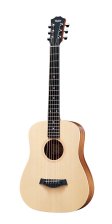
Review: Baby Taylor Guitar BT1 Natural

Purchase this Baby Taylor BT1 guitar on Amazon $319 (the one on the top left)

taylor BT1 baby acousticMy review: 5 stars. This is the Cadillac of student model 3/4 size guitars. Usually I recommend the more modest Yamaha JR1 (see my review of that model here), but you might want to splurge for this better-looking, better-sounding model if you meet the following criteria:
-The student is 12 years old or under (with the exception of those looking for a nice travel guitar).
-You’re okay with paying twice as much as the Yamaha.
-This guitar will do a better job holding its resale value when the time comes to transition to a larger instrument.
-There is also the option of retaining it to use as a travel guitar when you need to avoid the bulk of a full-sized model.
-You are reasonably certain that guitar is something the student will continue to pursue in the coming years.

Purchase this Baby Taylor BT1 guitar on Amazon $319 (the one on the top left)

What do you think? Leave your opinion in the comments below.


Wes Freeman is private guitar lesson teacher in the Atlanta metro area of Georgia. He teaches lessons primarily in the cities of Lilburn, Snellville, Marietta, Decatur, and Brookhaven. Learn more about taking lessons with Wes on his Lessons page.

Should my child take guitar lessons?

childAt what age can my child begin taking guitar lessons?

For students under the age of twelve, I strongly recommend beginning with ukulele instead of guitar. Ukuleles are in every way easier to physically manage than guitars for children. Strings are easier to press down, and there are fewer strings that are placed farther apart, making the instrument far less confusing. Most of what is learned on the ukulele is transferable to guitar, which makes for an easy transition when the student is ready. Fortunately, this also results in a student ultimately being proficient in two instruments instead of just one. For parents concerned about expense, ukuleles are generally much less expensive than guitars.

In my experience, any child can learn to play the ukulele, but because of the additional strength, dexterity, and focus required to excel at guitar, young students may have mixed results.

As long as all of this is understood, if a young student is resolved to skip the ukulele and pursue guitar, I will accept guitar students as young as seven. Because of the advantages mentioned above, I will accept ukulele students as young as five.

What is the commitment involved?
The single most important factor when it comes to learning the guitar or ukulele is the commitment to spending time on the instrument daily. In the beginning, the time commitment does not need to be great -as little as 5 to 10 minutes as long as days missed are the exception rather than the rule. For the most part, children – even older ones – are not going to make this happen on their own, so parents should be prepared to set a minimum practice limit and be willing to enforce it. Practicing must become a habit for the student (and in most cases, for the parent as well), so I encourage students to either practice at the same time every day or associate practicing with another habit, such as practicing immediately after dinner every night. It is also helpful to have some sort of “reward” at the end of a practice session to enforce this habit; this could be a simple as adding a sticker to a progress chart indicating your child has met that day’s practicing goal to give him/her a feeling of accomplishment.

What supplies do I need to get started?
Aside from the time and commitment to practice, all that is needed is a guitar or ukulele, picks, and a desire to learn. You can find my recommended guitars and supplies on my reviews page.

Ready to get started? Sign up for lessons!

What are your thoughts or questions? Leave a comment below.


Wes Freeman is private guitar lesson teacher in the Atlanta metro area of Georgia. He teaches lessons primarily in the cities of Lilburn, Snellville, Marietta, Decatur, and Brookhaven. Learn more about taking lessons with Wes on his Lessons page.

Review: Yamaha FG JR1 Acoustic Guitar 3/4 size

View more about this Yamaha beginner guitar

yamaha-jr1-guitarMy review: 5 stars. This is the best beginner acoustic guitar I typically recommend for students under 12. Having taught hundreds of students using this model, I can say unreservedly that it is worth the money. It sounds good and holds up well to the abuse that tends to be inflicted by younger students (though caution is still best advised). One of the best things about Yamaha is the consistency of what they produce; a major consideration for a starter guitar is ease of play and Yamaha can be relied on to give you that every time. It makes a great guitar for young new students or an upgrade from a cheap starter guitar.

What do you think of this guitar? Leave your thoughts in a reply below.

Purchase this Yamaha FG JR1 acoustic  guitar on Amazon

Check out more of my reviews here


Wes Freeman is private guitar lesson teacher in the Atlanta metro area of Georgia. He teaches lessons primarily in the cities of Lilburn, Snellville, Marietta, Decatur, and Brookhaven. Learn more about taking lessons with Wes on his Lessons page.